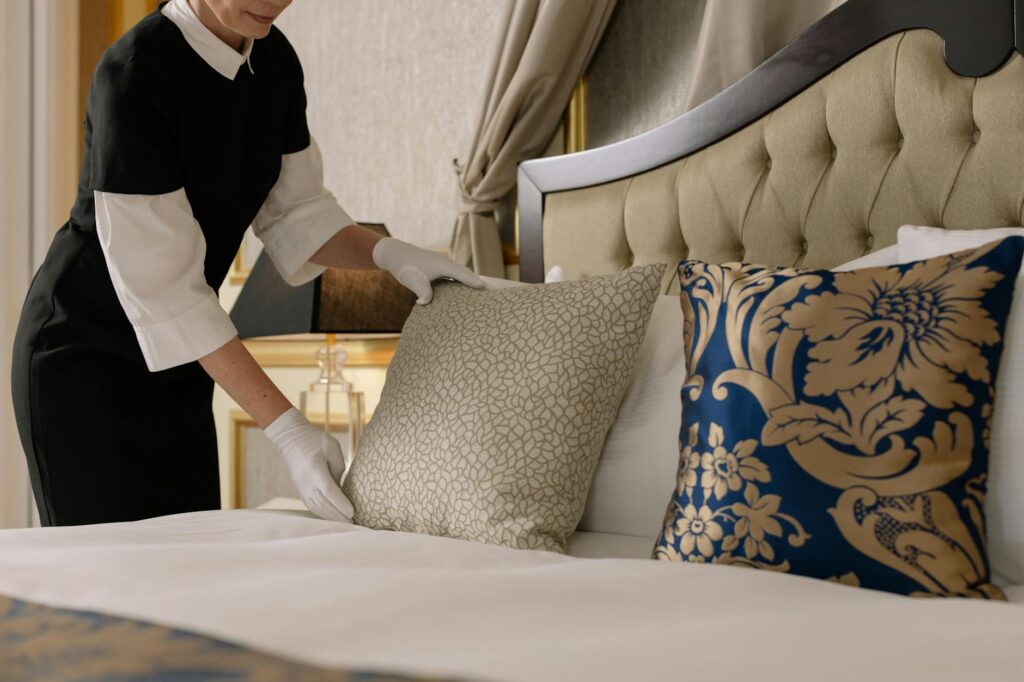
How Indianapolis Hotels Use Aprehend® for Bed Bug Control Without Closing Rooms
A bed bug complaint at an Indianapolis hotel is not a pest problem. It is an online-review problem, an ADA-accommodation problem, an OTA-ranking problem, and a room-revenue problem — usually all four inside a 24-hour window. The pest is real and needs to be dealt with, but the operational damage runs through TripAdvisor, Booking.com, Expedia, the corporate guest-services line, and the franchise QA scorecard before a single technician sets foot on the property. By the time the pest control vendor arrives, the front desk is already managing fallout.
The standard playbook — pull the room from inventory, schedule heat treatment, dark the room for 8–12 hours, hope the unit next door is not affected — was built for the residential market and stapled onto hospitality. It does not match how a hotel actually operates, and it does not match what a hotel actually needs from a pest program. Aprehend® is the biopesticide that does match. Here is how Indianapolis hotels are deploying it.
What Aprehend® Actually Is — And Why Hotels Care
Aprehend® is a biopesticide manufactured by ConidioTec, EPA-registered specifically for bed bug control in residential and commercial structural applications. Its active ingredient is Beauveria bassiana strain GHA — a naturally occurring entomopathogenic fungus that has been used in commercial agriculture for decades against soft-bodied insect pests. The relevant point for a hotel operator is that Aprehend is not a synthetic chemical insecticide. It is a fungal spore suspension. Bed bugs walk through it, the spores adhere to the cuticle, the spores germinate, and the fungus grows into the insect over the next 3–10 days. The bug dies inside that window.
There are three properties of Aprehend that change the operational math for hotels:
- It is transferable. A bed bug that picks up spores by walking through a treated band on a headboard or box-spring seam carries those spores back to harborage. The spores transfer to other bed bugs in the same harborage cluster through ordinary contact. One bug stepping on the residue can take down dozens of harboring kin. That multiplier matters because hotel bed bugs cluster in seams a residual spray cannot reach.
- It has a 90-day residual. Spores stay viable on treated surfaces for approximately three months. A hotel room re-treated at quarterly intervals has continuous protection — meaning the unit is not waiting for a guest to report a bite before the bug encounters a kill mechanism. The bug brought in a suitcase tonight gets killed by the residue from the application 60 days ago.
- It is not heat, and not a synthetic spray. Application is a precision band of fungal suspension applied to specific harborage routes — headboard back, box-spring seam, baseboard junction behind the bed, room entry door frame. Dry-down is approximately two hours. After dry, the residue is functionally invisible, has no odor, and is rated for re-occupancy. The room can return to inventory the same day the technician treated it.
The mechanism in one sentence. Aprehend uses living fungal spores that infect and kill bed bugs through cuticle contact and bug-to-bug transfer over a 3–10 day kill window, with 90-day residual on treated surfaces — which means the room does not need to be empty when the bug shows up.
Why Hotel Bed Bug Pressure Is Structurally Different
Bed bug pressure on a hotel is not the same problem as bed bug pressure on an apartment building, a single-family home, or a senior living facility. Three structural factors make hospitality unique, and each one points toward a different treatment philosophy than the residential default.
1. Turnover is the vector.
A 150-room property running 70% occupancy is moving roughly 38,000 guests per year through its rooms — and luggage from every one of those guests. Bed bugs are obligate hitchhikers. They do not fly, they do not jump, they enter a hotel inside a suitcase and they leave inside the next suitcase. A property cannot screen its way out of this. Every guest is a potential introduction event, every introduction event is statistically rare, and the rare event compounds across tens of thousands of stays. A property without a residual program is functionally relying on housekeeping to find the bug before the bug finds a guest. That is not a defensible position for a 100-key plus property.
2. The damage runs through reviews, not bites.
Bed bug bites are uncomfortable but rarely medically serious for the average guest. The financial damage to the hotel comes from the public record the complaint creates. A single TripAdvisor review with the words ‘bed bug’ in the body text demonstrably affects bookings for months — third-party studies have measured booking declines in the 20–40% range against properties with active bed bug review mentions, with recovery times of 6–18 months even after the issue is fully resolved. The OTAs and corporate franchise QA programs both surface complaint data. One verified complaint costs the property far more than the treatment ever does.
3. Guest accommodation is a legal exposure, not an option.
A guest who reports being bitten is, in many cases, presenting a possible ADA-protected health condition (chronic skin sensitivity, allergic reaction, asthma triggered by environmental exposure). The standard front-desk response — comp the night, move the guest, log the incident — is not optional and is not cheap. A 4-night stay re-comped, plus a comparable room at a comparable property booked on the hotel’s tab, plus laundering allowance, plus the original revenue lost, runs $1,200–$3,500 per documented incident before any review damage. If three guests report from the same wing in the same week, that line on the GM’s monthly P&L turns red.
Why Heat Treatment And Conventional Sprays Fall Short For Hospitality
The two dominant treatment modalities the hospitality industry has used for the last decade — thermal remediation (heat) and synthetic residual sprays (typically pyrethroid or neonicotinoid blends) — were both designed primarily for the residential market. They each have a place in a complete program, but neither, used alone, fits the hotel operating model.
Heat treatment: effective, but the room is dark all day.
Heat treatment uses portable propane or electric heaters to raise an entire room to ~120-135°F for several hours. Done right, it kills bed bugs at every life stage — eggs, nymphs, adults — in a single application. The catch for hotels is operational: the room is out of inventory for 8–12 hours minimum, including ramp-up, kill-window, and cool-down. Adjacent rooms cannot be sold during the treatment because of fire-watch, smoke-detector isolation, and shared-wall heat bleed. Furniture, electronics, and certain finishes can be heat-damaged if the protocol is not run perfectly. And once the heat treatment ends, there is zero residual. The next bug a guest brings in tomorrow will not encounter anything to kill it.
Conventional residual sprays: residual exists, but the spectrum is shrinking.
Synthetic residual products (typically a pyrethroid + neonicotinoid combination, sometimes with desiccant dust) leave a treated film on baseboards, mattress encasements, and box-spring seams. Properly applied, they do offer residual protection — but pyrethroid-resistant bed bug populations have been documented in field surveys for over a decade, and resistance levels are now assumed in any commercial bed bug strain encountered in 2026. Resistant populations walk across pyrethroid residue without being killed. Synthetic sprays also carry odor, visible film concerns on dark-colored finishes, and sometimes a label-required vacate window after application that the room schedule has to accommodate.
Where Aprehend fits in the stack.
Aprehend works because the active ingredient is biological, not chemical. Resistance to a fungal pathogen develops on a different (and slower) evolutionary timeline than resistance to a synthetic neurotoxin. Field surveys to date show no documented Aprehend resistance in commercial bed bug populations. Combined with transferable spore mechanics and the 90-day residual, Aprehend gives the hotel something neither heat nor pyrethroid spray can give: continuous, low-impact, audit-documentable protection that does not require pulling rooms from inventory.
How Aprehend® Works Mechanically — Spores, Transfer, And Kill Window
For the GM or director of housekeeping who has to explain the program to a guest, a corporate auditor, or a regional ops review, the mechanism is worth understanding at the right level of detail. Aprehend is not a contact-kill product. It is a delayed-kill, transfer-driven product, and the delay is the feature.
- Application creates a precision band. A trained applicator uses a low-pressure handheld sprayer to apply a thin, precise band of fungal suspension to specific harborage routes inside the room. The band is targeted — headboard back, box-spring seam line, the wall junction directly behind the bed, the lower edge of the door frame, and the perimeter of any upholstered furniture in the room. Broadcast spraying is not the protocol; the band targets where bed bugs travel.
- Spores adhere to the bed bug cuticle. A bed bug walking across the dried band picks up fungal spores on its legs and underbelly. The cuticle (exoskeleton) is the entry point — the spores need direct contact with the insect’s body to start the infection cycle. The bug typically does not change its behavior in the first 24-48 hours; it returns to harborage and continues normal feeding patterns.
- Transfer to harboring kin. Bed bugs cluster tightly in harborage. An infected bug that returns to a cluster transfers spores to other bugs through normal aggregation contact — pheromone-driven huddling, mating contact, communal harborage in box-spring seams or behind headboards. This is the multiplier: one bug picks up the residue, ten bugs in the same harborage carry the pathogen.
- Spores germinate and the fungus grows internally. Over 3-7 days, the spores germinate, penetrate the cuticle, and begin growing through the insect’s body cavity. The bug becomes lethargic in days 5-8 and dies in days 7-10 from the time of original contact.
- The 90-day residual maintains the trap. The dried band on treated surfaces remains spore-active for approximately three months. New bugs entering the room (in a suitcase tonight, in housekeeping equipment tomorrow) encounter the same band and start the same cycle.
The Hotel Treatment Protocol — Room By Room, No Inventory Closure
The protocol that hospitality operators care about is the operational one: what does it do to my room schedule? The answer is materially different from heat or aggressive synthetic spray treatment. Here is how a typical Indianapolis hotel deployment runs.
- Pre-treatment inspection. Tech walks the room (or wing, or property — depending on whether this is incident response or quarterly preventive). Inspection focuses on harborage signs: cast skins, fecal staining, live bugs in seams. Detection is documented per room with photo evidence on the service log.
- Targeted application. Aprehend is applied as a precision band to defined harborage routes. Per-room application time is roughly 15-25 minutes depending on room layout and furniture density. No furniture removal, no occupant belongings disturbed (on incident response — preventive applications happen during housekeeping windows).
- Dry-down: approximately 2 hours. The room is left undisturbed during dry-down — windows open, HVAC on normal cycle is fine. After roughly 120 minutes, the residue is dry, invisible to a guest, and rated for re-occupancy.
- Re-inventory same day. Once dry, housekeeping can run a final turn on the room and it goes back into the booking inventory. No overnight closure required, no adjacent-room evacuation, no fire watch. This is the operational difference from heat treatment.
- Pet-friendly and re-occupancy-rated. Aprehend’s label specifically permits re-occupancy after dry-down. Service dogs, pet-friendly room policies, and ADA-accommodation guests all remain compatible with the application protocol. The MSDS/SDS supports the re-occupancy claim and is documented for audits.
- Quarterly cycle for preventive coverage. Properties running Aprehend as a preventive program rotate the property on a roughly 90-day cadence — every room treated once per quarter, scheduled around occupancy windows. Incident-response treatments outside the cycle are added as flagged.
The single biggest operational fact: Aprehend does not pull a room from inventory overnight. The 2-hour dry-down means a room treated mid-morning is bookable again by check-in. This is the line item that changes the financial case versus heat — and it scales linearly across a 150-key property running quarterly preventive.
Documentation: What Hospitality Audits Expect To See
Hotel pest programs live or die by documentation. A franchise QA audit, a corporate ops review, an OSHA visit, or — in a worst-case scenario — a guest-injury legal discovery process all want the same thing: a defensible paper trail showing the property was actively managing bed bug risk. The treatment itself is half of the program; the documentation is the other half.
Two parallel logs.
Hospitality bed bug documentation runs in two parallel streams that should both exist on every property:
- Housekeeping inspection log. Maintained by the property. Records routine room checks during turns — visual inspection of mattress seams, headboard back, box-spring corners. Format is typically a simple per-room checkbox sheet with date, room number, housekeeper initials, and a flag column for escalation. Most major franchise QA programs require this in some form. The Aprehend program does not replace this — it complements it.
- Pest service log. Maintained by the pest control vendor. Records every service visit by date, technician name, rooms treated, product applied, application rate, and any activity observed. Photo evidence of harborage findings is increasingly expected. The service log is what gets requested in a corporate audit, in a guest complaint follow-up, and in any legal exposure scenario. ProTech’s service reports include the technician’s Indiana OISC pesticide applicator license number, the EPA registration number for the product applied, and per-room application notes.
What auditors specifically look for.
A trained hospitality QA auditor reviewing the pest file is looking for four things in roughly this order: (1) is there a written program scope on file from the vendor, (2) are service visits happening on the contracted cadence with no unexplained gaps, (3) is incident response documented when complaints occur, (4) is the technician licensed in the state of operation. A program that produces clean documentation on all four passes audit. A program with treatment but missing documentation fails audit even if the actual pest pressure is well-controlled.
Compliance: ConidioTec Registration And Indiana OISC Licensing
Two regulatory layers govern the application of Aprehend at an Indianapolis hotel, and both should be visible in the service file.
Federal — the product itself.
Aprehend® is registered with the U.S. EPA as a biopesticide and is sold exclusively to licensed pest control professionals (it is not available retail). The product registration covers the active ingredient (Beauveria bassiana strain GHA), permitted use sites (residential and commercial structural), permitted application methods, and re-occupancy/re-entry intervals. ConidioTec, as the manufacturer, also operates an applicator certification program — only certified applicators are sold the product. The vendor’s certification number should be on file with the service log.
State — the applicator.
Indiana regulates pesticide application through the Office of Indiana State Chemist (OISC), housed at Purdue University. Any individual applying a pesticide (including a biopesticide like Aprehend) at a commercial Indiana property must hold a valid Indiana commercial applicator license under the appropriate category — for hospitality bed bug work, that is typically Category 7A (General Pest Control) or Category 7B (Wood-Destroying Pest Control, when expanded). The applicator’s license number, expiration, and category should appear on every service log. OISC publishes a public licensee lookup; auditors do verify.
Cost Versus Heat Treatment — And The ROI Math
The financial comparison between Aprehend and heat treatment looks different on a single-room incident than it does on a property-wide preventive program. Operators who only run the math on the per-incident cost miss the larger picture; the room-out-of-inventory cost is where the gap actually opens up.
| Modality | Per-Room Cost (Treatment) | Room Downtime | Residual Coverage | Resistance Risk | Re-Occupancy |
|---|---|---|---|---|---|
| Aprehend® biopesticide | $200-$400 per room (incident); lower per-room on quarterly preventive | ~2 hours dry-down, then re-inventory same day | ~90 days continuous on treated surfaces | No documented field resistance to date | Rated re-occupancy after dry; pet-friendly; ADA-compatible |
| Thermal (heat) treatment | $500-$1,500+ per room (single application) | 8-12 hours minimum; adjacent rooms also dark for fire-watch | Zero — kill is single-event, no protection after cool-down | Resistance not applicable (kill is thermal, not chemical) | After cool-down only; heat-sensitive items must be removed |
| Pyrethroid + neonic residual spray | $150-$300 per room | Variable label vacate window; sometimes 4-8 hours | 30-60 days, declining | Documented field resistance widespread by 2026 | After label vacate window; some products restrict pet re-occupancy |
| Aprehend on quarterly preventive cycle | $60-$120 effective per-room (amortized across program) | ~2 hours dry-down, scheduled around occupancy | Continuous (refreshed every 90 days) | No documented field resistance to date | Rated re-occupancy after dry |
The line that does the work in this table is room downtime. A 150-key property running 70% ADR-weighted occupancy at, say, $140 average daily rate, loses approximately $98 per room per night the room is dark. A heat treatment that takes a room out of inventory for an effective overnight cycle costs the treatment itself plus roughly that $98 in lost revenue — and if adjacent rooms are also held off-sale during the treatment window, the lost-revenue line stacks. An Aprehend treatment that returns the room to inventory before check-in eliminates the lost-revenue line entirely. Run that math across a quarterly property cycle and the cost story flips.
What ProTech Brings To Hospitality Accounts In Indianapolis
ProTech Pest Control is owner-operated by Stephen Hill and works commercial accounts only across Marion County and the surrounding eight counties (Hamilton, Hendricks, Johnson, Hancock, Boone, Morgan, Shelby, and Madison). For hospitality clients specifically, that translates to a few operational facts that matter for the program:
- Same technician every visit. Hospitality accounts get assigned to one tech who learns the property layout, the housekeeping team, the seasonal patterns, and the franchise QA cycle. Rotating-tech models miss room-specific harborage history; we do not run that model.
- No call center, no subcontractors. Service calls go to the owner. Treatments are performed by ProTech personnel, not subbed out. The technician on the property has the certification, the license, and the institutional memory — not a dispatcher in another state.
- Commercial-only book. Commercial accounts get a different documentation format, scheduling logic, and product approach than residential. Vendors splitting their book across both sometimes default to residential methodology on commercial sites. We do not have a residential book.
- Indiana OISC-licensed applicators. Every technician applying Aprehend at an Indianapolis hotel holds the appropriate Indiana commercial applicator license. License numbers appear on every service log.
- ConidioTec-certified for Aprehend application. Aprehend is sold only to certified applicators. The certification number is on file and appears on the service report.
Next Steps For Hotel Operators With Active Or Suspected Bed Bug Pressure
If your property has had a recent guest complaint, a housekeeping flag, or an OTA review mention — or if you simply want to move from a reactive heat-treatment program to a preventive Aprehend cycle before the next complaint comes in — the right first move is an on-site walkthrough, not a phone quote. We assess the actual property, the actual room layouts, the actual occupancy cycle, and build the program around your operating reality. Request a commercial walkthrough on our free quote page, or read more about the program on our Aprehend® bed bug treatment page and our hotels and hospitality industry page. We service the entire Indianapolis metro.
Active complaint, OTA review hit, or moving off heat-only?
We run hotel Aprehend programs across the Indianapolis metro on quarterly preventive cycles and on incident response. Tell us the property, the wing, and what is actually happening — we work the schedule around your occupancy, not the other way around.