
Marion County Health Department Inspection Prep: The Pest-Documentation Checklist
Most Indianapolis restaurant operators meet the Marion County Public Health Department inspector for the first time during the inspection itself. By that point, three things have already been decided: whether your pest-management documentation is in order, whether your back-of-house walkthrough caught what the inspector is about to flag, and whether the live activity nobody mentioned at the staff meeting two weeks ago has now become a citation. None of those three are decided in the moment. They’re decided weeks earlier — in the walkthroughs, the service logs, and the corrective-action plans that exist before the inspector ever shows up.
This is the prep checklist we walk every commercial kitchen account through. It’s not an exhaustive food-code primer — it’s the pest-and-sanitation slice of a Marion County food-service inspection, written for the operators we work with: GMs, chef-owners, and multi-unit operations directors who don’t have a corporate compliance department running interference for them.

What MCPHD Actually Inspects (Under FDA Food Code 2022)
Indiana adopted the FDA Food Code 2022 framework, and Marion County Public Health Department food-service inspectors work from that document plus state and county-level overlays. The Food Code organizes violations into two broad categories that drive the entire inspection: priority items (the things most directly tied to foodborne illness and contamination) and core items (general sanitation, facility maintenance, and good retail practices). Pest evidence touches both, but lands in the priority bucket the moment live activity or active contamination shows up near food-contact zones.
On a typical routine inspection, the inspector arrives unannounced during operating hours, presents credentials, and starts a walkthrough that follows food flow from receiving through storage, prep, cook, hold, service, and warewashing. Pest-related observations get recorded throughout that walk — not at a single station — and they’re cross-referenced against your written pest-management records before the inspection report is finalized.
The pest-related categories the inspector is documenting fall into roughly six buckets:
- Live activity. Any live insect or rodent observed in the food-service operation during inspection hours. This is the most severe pest finding and almost always escalates the inspection.
- Evidence of activity. Roach droppings (small pepper-like specks), rodent droppings (rice-grain shape), shed skins, egg cases, gnaw marks, smear marks along baseboards, urine staining under UV inspection, or product damage consistent with pest activity.
- Conditions conducive to pests. Standing water, accumulated grease, unsealed exterior penetrations, gaps under exterior doors greater than 1/4 inch, missing screens, dumpster lids left open, vegetation against the building, or structural conditions that create harborage.
- Pest-management program records. Your professional pest control service logbook, contract, applicator license documentation, product labels and SDS sheets, and treatment-location records.
- Corrective-action documentation. If a previous inspection flagged pest evidence, what was done, when, by whom, and is it being monitored.
- Employee practices and training. Whether staff are trained to report sightings, whether sighting logs exist, whether food deliveries are being inspected for pest activity at the back door.
The two-document floor. At minimum, MCPHD inspectors expect to see a current pest-control service contract and the most recent service log on-site, accessible during the inspection. Not in a binder at the corporate office. Not in an email attachment. On the wall, in a folder behind the host stand, or in a manager’s binder a staff member can produce in under two minutes.
Common Pest-Related Violations Cited in Indy
Across the Indianapolis metro restaurant accounts we service, the pest-related violations MCPHD cites most often aren’t the dramatic ones. They’re the routine, fixable, predictable observations that keep cropping up because nobody on staff is doing the pre-inspection walk that would catch them. In rough order of frequency:
1. German cockroach evidence behind warewashing.
Droppings on the wall behind the dish machine, egg cases wedged into the seam where a stainless splash meets the tile, or shed skins on the floor under the spray-arm. Dish line is the highest-pressure German roach harborage zone in any commercial kitchen — see our German cockroach commercial kitchen guide for why. Inspectors know to look here first.
2. Rodent droppings in dry storage.
Mouse droppings (small, dark, rice-grain shape) on shelving, behind cardboard boxes, or along the floor edge of dry storage rooms. Rats produce larger droppings — same locations but harder to miss. Rodent evidence in any food-storage area is a priority finding.
3. Drain fly and fruit fly activity at the bar and mop sink.
Drain flies (small, fuzzy, moth-like) breeding in floor drains, mop-sink drains, and the gunk inside soda-gun holsters or beer-line drip trays. Fruit flies clouding above produce stations, recycling bins, or unsealed wine. Both are evidence of organic buildup that needs correction — not just a pest-control treatment.
4. Missing or incomplete pest-management records.
Service log is on-site but doesn’t list applicator license number. Product labels missing for materials being applied. No documented response to a previous sighting. Signed service tickets but no actual service notes describing what was treated, where, and what activity was observed. This is the violation that turns a medium finding into a severe one.
5. Conditions conducive to pests at the dumpster pad and exterior.
Dumpster lids open, dumpster pad ungraded with standing water, gaps around exterior door sweeps, unsealed utility penetrations, or vegetation/landscaping touching the building exterior. The kitchen can be spotless — if the back door is gapped at the bottom, that’s the inspection finding.
6. Stored-product pests in dry goods.
Indianmeal moths in flour, weevils in rice or grains, beetles in spice containers. Often arrives with a delivery and goes unnoticed until product is opened. Receiving inspection at the back door is the prevention point — most operators skip it.
The Pest-Documentation Evidence Categories Inspectors Look For
The single biggest difference between facilities that sail through MCPHD inspections and facilities that get cited isn’t the absence of pests — it’s the presence of documentation. Even a kitchen with active pressure can score significantly better when the pest-management program is documented to FDA Food Code standards. Here are the seven evidence categories a complete program produces:

- Service log / service ticket per visit. Date, time-in/time-out, technician name, applicator license number, summary of work performed, activity observed, recommendations for the operator. Digital or paper — but signed and dated.
- Product labels and Safety Data Sheets (SDS) on-site. For every active material being applied at the facility — gel baits, IGRs, rodenticides, drain treatments — the EPA-registered label and current SDS must be available to the operator. Most professional providers maintain a binder or digital folder per account.
- Applicator license documentation. Indiana requires commercial applicators to hold a current license issued by the Office of Indiana State Chemist (OISC). The license number should appear on every service ticket. Operators can verify it directly with OISC.
- Treatment-location map or list. Where bait stations are placed, where monitoring stations are placed, where rodent stations are located on the exterior. Inspectors will sometimes physically walk to a station to confirm it exists where the records say it does.
- Monitoring station logs. Sticky traps, glue boards, and rodent stations checked on each visit, with activity counts recorded. Empty trap = good record. Trap not checked in three months = bad record.
- Corrective-action plan. When activity is observed, the response in writing — what was treated, when the follow-up is scheduled, what the operator is doing in parallel (sanitation, exclusion, structural repair).
- Sighting log for staff. A simple form (paper or digital) where any staff member can record date/time/location/what-they-saw. Inspectors love seeing this because it shows the operator has a culture of reporting, not concealing.
MCPHD Violation Severity vs. What Good Documentation Does
The chart below isn’t a substitute for the actual inspection report categories — MCPHD uses the FDA Food Code priority/core framework — but it’s how we explain to operators what changes when documentation is in place vs. missing on the same observed condition. Same kitchen, same pest evidence, very different inspection outcome:
| Observed Condition | Without Pest-Management Documentation | With Complete Pest-Management Documentation |
|---|---|---|
| Single live cockroach observed in back-of-house | Priority violation, immediate corrective action required, re-inspection scheduled, high risk of escalated future inspection cadence | Priority violation flagged, but corrective-action plan already on file with active treatment scheduled — re-inspection still possible but inspector has evidence the issue is being managed |
| Mouse droppings observed in dry storage | Priority violation, contaminated product disposal required, re-inspection scheduled, conditions-conducive review of structural exclusion | Priority violation flagged, monitoring-station log shows recent activity drops, exclusion repair documented in service log — corrective action accelerated |
| Drain fly activity at bar drains | Core violation for evidence of pests, plus core violation for organic accumulation in drains | Core violation noted, but log shows scheduled drain treatments and sanitation correction — typically fixed at re-inspection |
| No pest-control service records on-site | Core violation for missing required documentation, may escalate any other pest finding to higher severity | N/A — documentation present means this finding does not occur |
| Gap under exterior delivery door | Core violation for conditions conducive to pests | Same core violation — but if the service log has flagged it previously and shows operator was notified, severity is reduced because the issue is on a corrective-action timeline |
Documentation doesn’t make pest evidence go away. A mouse dropping is still a mouse dropping. What documentation does is change the violation severity, the corrective-action window, and whether the inspector reads your kitchen as ‘unmanaged’ or ‘actively managed with a known issue.’ Those two read very differently in a re-inspection report and at permit-renewal time.
Pre-Inspection Walkthrough Checklist (Back-of-House Order)
Run this walk in the same order an MCPHD inspector typically follows food flow. Allow 45–90 minutes for a thorough first pass on a single-location restaurant; allow longer if you’ve never run one before. The first time finds the most issues. After that, the same walk takes 25 minutes.
Receiving / Back Door
- Door sweep intact, no gap larger than 1/4 inch under the door when closed.
- Door not propped open during deliveries longer than the actual unload window.
- No cardboard accumulation at receiving (cardboard is the #1 pest delivery vector).
- Receiving area swept clean of food debris and shrink-wrap residue.
Dry Storage
- All product on shelves, not on floor (6″ off floor minimum).
- First-in-first-out rotation visible — dated containers, no buried back-of-shelf inventory.
- Damaged or open packaging consolidated into sealed containers.
- No droppings on shelving, behind shelving, or along baseboards.
- Walls and floor edges visually clean, no smear marks, no nesting material.
- Monitoring stations or glue boards visible and currently checked per service log.
Walk-Ins (Cooler and Freezer)
- Door gaskets intact and clean — gasket channel is a major German roach harborage.
- Floor drains (if present) clean and not pooling.
- Compressor / condensate area accessible and not cluttered with stored items.
- Light fixtures shielded; no flying-insect accumulation in fixtures.
- Shelving 6″ off floor; nothing stored on floor.
Prep, Cook, and Hold Lines
- Under-counter equipment cleaned out — fryer cabinets, prep table interiors, reach-in cooler bottoms.
- Equipment seams and screw heads checked for egg cases / droppings.
- Hood filter clean, no grease drip onto cook line.
- Wall-mounted equipment caulked tight to wall, no harborage gap behind.
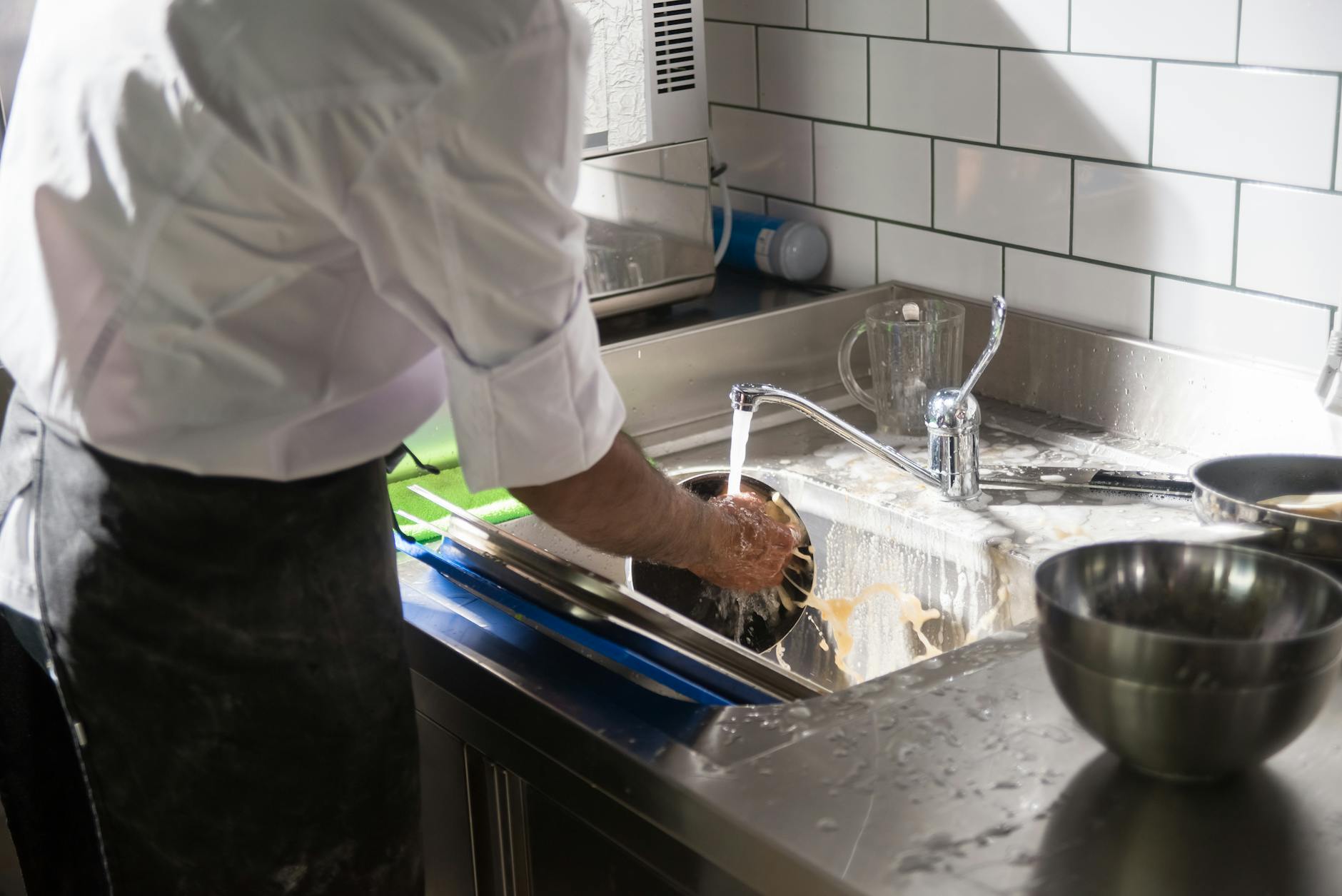
Dish Line / Warewashing
- Wall behind dish machine clean, no smears, droppings, or grease accumulation.
- Floor sink / floor drain clean and grated.
- Spray-arm splash zone caulked where wall meets equipment.
- Mop sink clean, drain not clogged, no standing water, mop not stored wet on floor.
Bar (if applicable)
- Soda-gun holsters cleaned, drip trays empty.
- Beer-line drains flushed and treated for drain fly activity.
- No fruit-fly activity around garnish station, citrus storage, or recycling.
- Liquor storage room dry, sealed, no rodent droppings.
Restrooms / Mop Closet / Janitorial
- Drains clean, not pooling.
- Chemicals stored separated from food and food-contact surfaces, properly labeled.
- Floor edges clean, no organic buildup at corner where wall meets floor.
Exterior Perimeter / Dumpster Pad
- Dumpster lids closed.
- Dumpster pad swept, no spilled food waste accumulation.
- Pad graded for drainage — no standing water around dumpster.
- Exterior building penetrations sealed (utility chases, conduit holes, expansion joints).
- No vegetation or landscaping touching building wall.
- Exterior rodent stations present, locked, secured, and currently logged.
If You See Live Activity in the 48 Hours Before Inspection
It happens. A line cook spots a roach in the dish area at 11pm. A prep cook finds droppings behind the flour bin at 6am the day of inspection. The instinct is always the same and always wrong: grab whatever consumer-grade can is in the back-of-house and start spraying. Don’t.
Three reasons this is the worst possible move. One: any product applied without an applicator license, without an EPA-registered label on-site, and without service documentation is itself a violation. The inspector will ask what was applied. Two: consumer-grade aerosols are almost universally repellent — they push the population deeper into harborage and scatter it into adjacent areas, making the inspection-day situation worse, not better, by the time the inspector arrives. Three: any chemical residue near food-contact surfaces is a separate priority violation. You can turn a single sighting into a contamination event by trying to spray it.
The correct response, in order:
- Document what was seen, where, and when. Take a phone photo if possible. Log it in your sighting log. This evidence becomes part of your corrective-action record — it shows the operator caught it, not the inspector.
- Call your pest-control provider. Ask for an emergency or rush-priority visit. A commercial-only provider should be able to schedule an after-hours or pre-open visit when a re-inspection or audit is on the calendar.
- Clean the area thoroughly. Sanitation correction is something you can do right now. Pull the equipment, deep-clean behind it, address grease accumulation, fix the broken caulk line. This doesn’t kill the pest — but it removes the conducive condition.
- Don’t conceal evidence. Wiping droppings is fine. Rearranging product to hide gnaw marks or covering monitoring stations is not. Inspectors find concealment indicators frequently and it materially escalates findings.
- Have your service log and corrective-action plan ready at the door. When the inspector arrives, the first thing you say is: ‘We had a sighting Tuesday night. It’s documented in our log, our pest provider was on-site Wednesday morning, here’s the service ticket and the corrective action.’ That sentence changes the inspection.
Phone tree. Every commercial kitchen we service has the after-hours emergency line on a sticker inside the manager’s office. Save it. The 30 seconds it takes a GM to find a phone number on a Tuesday at 11pm is the difference between a same-night response plan and a sighting that goes untreated for 36 hours.
How to Read Your Re-Inspection Notice and Timeline
If the inspection results in flagged pest items, the inspection report will include corrective-action language and a re-inspection window. The exact language varies by finding severity, but the structure is consistent:
- Priority items (live activity, contamination near food-contact surfaces, severe rodent evidence) — typically require correction within a short window (often 10 days, sometimes shorter for the most severe findings) with a re-inspection scheduled at the end of that window.
- Core items (conditions conducive, evidence without live activity, documentation gaps) — typically a longer corrective-action window, often verified at the next routine inspection rather than a separate visit.
- Repeat findings within the same 12-month inspection cycle — escalate severity and shorten the window. The same finding twice in a row is treated more seriously than two unrelated findings.
- Imminent health hazard findings — these are the rare findings serious enough to result in immediate operational restriction (closure, partial closure, or permit suspension). Pest-related, this is typically reserved for severe rodent infestation or repeated failure to address active conditions.
Read the report carefully on the day it’s delivered. Confirm the corrective-action window dates. Schedule the corrective work — including any pest-control service required — well inside the window, not at the deadline. Your re-inspection is the inspector verifying that what they cited is fixed; if they arrive and find the same condition, you’ve created a repeat finding, which is worse than the original.
Permit-Pull Triggers vs. Routine Violation Thresholds
It’s easy to overstate the consequences of a pest finding. The reality is more nuanced. The vast majority of pest-related findings at MCPHD inspections result in corrective-action requirements and re-inspections — not permit suspensions or closures. Here’s the honest threshold framework as we’ve seen it operate across our restaurant accounts:
- Single live cockroach sighting, otherwise clean kitchen, complete documentation. Almost always a priority violation with a corrective-action window and a re-inspection — not a closure.
- Multiple live sightings, evidence on equipment, no documentation. More serious. The combination of active infestation plus absent management is what raises the inspection’s overall classification. Re-inspection is certain; depending on severity, the operator may face restricted operations until the issue is verified resolved.
- Severe rodent activity (multiple live rodents observed, widespread droppings, contaminated product). The most serious pest-related finding. Imminent health hazard classification is on the table here, which can result in voluntary or mandated closure pending correction.
- Repeat severe findings within a single inspection cycle. The pattern matters as much as the individual finding. Operators with a clean inspection history have more latitude than operators with prior pest citations on file.
- Concealment or interference. Findings that suggest the operator hid evidence, removed monitoring stations before the inspection, or interfered with the inspector’s walkthrough escalate independently of the underlying pest finding.
We say all of this not to minimize the importance of getting it right — every Indianapolis restaurant operator should treat MCPHD inspections seriously — but to be factual. A single sighting doesn’t pull a permit. What pulls a permit is a pattern of inadequate management, severe contamination, or operator behavior that signals the facility isn’t being run to standard. Documentation, sanitation, and a real pest-management program prevent the pattern. They don’t prevent every finding, but they prevent the findings that escalate.
Working With a Commercial-Only Pest Provider for Inspection Readiness
The pest-management documentation an MCPHD inspector wants to see isn’t generated by a residential pest-control company servicing your kitchen on the side. It’s generated by a commercial program that knows what FDA Food Code 2022 requires and structures every service visit to produce that evidence. At ProTech we run commercial-only — restaurants, food production, healthcare, multifamily, manufacturing, hospitality — and our service tickets are built specifically for the audit categories MCPHD and corporate third-party programs request.
What that looks like in practice for the restaurant operators we serve: the same technician shows up every visit (no rotating roster, no call-center dispatch), service is scheduled around your operating hours rather than ours, the service log is left on-site in the format your inspector expects, and when an active issue surfaces between visits we prioritize it on the dispatch schedule rather than pushing it to the next routine cadence. Stephen Hill recently took over ownership of ProTech and has kept the company commercial-only with no subcontracted technicians. When you call, you reach the company directly.
Our service area covers Marion County and the eight surrounding counties — Hamilton, Hendricks, Boone, Hancock, Shelby, Johnson, Morgan, and Madison. If you’re an Indianapolis restaurant operator preparing for a routine MCPHD inspection, recovering from a flagged inspection, or switching providers because your current company isn’t producing the documentation your inspector wants, request a commercial pest-control quote or see our restaurant pest-control program page for how we structure ongoing service. You can also reach us directly at (317) 854-5419.
MCPHD inspection on the calendar?
We prioritize inspection-readiness visits on our dispatch schedule for Indianapolis restaurant accounts. If you have a routine inspection, a re-inspection, or a corporate audit coming up, tell us when — we structure the visit, the documentation, and the corrective-action plan to match the date. Owner-operated, no call center, no subcontractors.